


Page 7 - pesta2015_4
P. 7
Side 7                 -pest-POSTEN


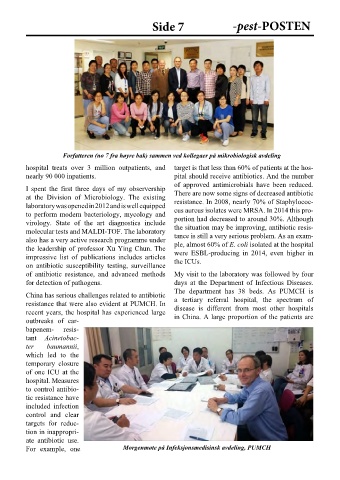
                   Forfatteren (no 7 fra høyre bak) sammen ved kollegaer på mikrobiologisk avdeling
        hospital  treats  over  3 million  outpatients,  and  target is that less than 60% of patients at the hos-
        nearly 90 000 inpatients.                 pital should receive antibiotics. And the number
                                                  of approved antimicrobials  have been reduced.
        I spent the first three days of my observership
        at the Division of Microbiology. The existing   There are now some signs of decreased antibiotic
        laboratory was opened in 2012 and is well equipped   resistance. In 2008, nearly 70% of Staphylococ-
        to perform modern bacteriology, mycology and   cus aureus isolates were MRSA. In 2014 this pro-
        virology.  State  of  the  art  diagnostics  include   portion had decreased to around 30%. Although
        molecular tests and MALDI-TOF. The laboratory   the situation may be improving, antibiotic resis-
        also has a very active research programme under   tance is still a very serious problem. As an exam-
        the leadership of professor Xu Ying Chun. The   ple, almost 60% of E. coli isolated at the hospital
        impressive list of publications  includes articles   were ESBL-producing  in 2014, even  higher  in
        on antibiotic  susceptibility  testing,  surveillance   the ICUs.
        of  antibiotic  resistance,  and  advanced  methods  My visit to the laboratory was followed by four
        for detection of pathogens.               days at the  Department  of Infectious  Diseases.
                                                  The department  has 38 beds. As  PUMCH  is
        China has serious challenges related to antibiotic   a tertiary  referral  hospital,  the spectrum  of
        resistance that were also evident at PUMCH. In   disease  is different  from most  other  hospitals
        recent years, the hospital has experienced large   in China. A large proportion of the patients are
        outbreaks of car-
        bapenem-   resis-
        tant  Acinetobac-
        ter   baumannii,
        which led to the
        temporary closure
        of one ICU at the
        hospital. Measures
        to control antibio-
        tic resistance have
        included  infection
        control  and clear
        targets  for  reduc-
        tion in inappropri-
        ate  antibiotic  use.
        For example, one            Morgenmøte på Infeksjonsmedisinsk avdeling, PUMCH

